
Dürr is an international player recognized for its expertise in innovative industrial technologies. Among its activities, the company develops and manufactures thermal machines of the ORC type (Organic Rankine Cycle), allowing to valorize waste heat into electricity in a powerful and sustainable way. Thanks to this know-how, Dürr establishes itself as a trusted partner to support manufacturers in their energy transition. This partnership allows us to integrate high-power, reliable and efficient high-temperature ORC solutions at our customers’ premises, in order to reduce their primary energy consumption and CO emissions.
The Dürr Cyplan®COROs in 3 key points:
- Decarbonized electricity production
- Possibility of cogeneration (useful heat + electric energy)
- Interesting return on investment times
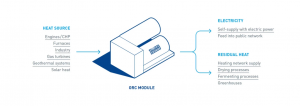
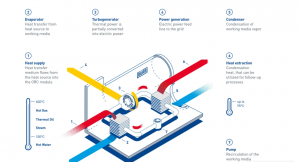
The Dürr Cyplan® ORC module operates on a closed cycle that turns heat into electricity. Heat from a source (gas, steam, thermal oil or hot water) is transferred to the ORC facility. This energy makes it possible to vaporize a working fluid, which, under pressure, drives a turbogenerator. The mechanical energy produced is converted into electricity.
After passing through the turbine, the fluid is cooled and recondensed, then reinjected into the circuit thanks to a pump, which allows the cycle to be repeated continuously. In addition, the extracted heat can be recovered as useful heat (up to 95 °C), for example to supply other industrial processes.
Below are some examples of sectors presenting valuation opportunities with the ORC modules from Dürr Cyplan®
- Cement works
- Glassware
- Steel industry
- Incineration
- Chemistry
All other activities generating high-temperature thermal fluxes can be valued thanks to the Dürr Cyplan ORC module.
| characteristics | Values |
|---|---|
| Electric power range | 50 kW to 3.000 kW (standardized modules, higher power at 3000 kW upon request) |
| Minimum temperature heat source | > 350 °C |
| Thermical power required | ≥ 200 kWh |
| Internal consommation | ~7% of electricity production |
| Recoverable heat at output | Up to 95 °C (cogeneration) |
The Cyplan® ORC modules stand out for their ability to operate in cogeneration, simultaneously producing electricity and useful heat at 95 °C. They provide a complete turnkey solution, from planning to commissioning, built with robust, proven, and highly efficient components. Designed for maximum performance, these high-temperature ORC systems can use either flue gas or thermal oil as heat sources, achieving an overall efficiency of more than 95% in CHP configuration. Their hermetically sealed design ensures the highest safety standards, while the modular and standardized concept allows for short delivery times. Fully automated and requiring no water consumption during operation, they also offer excellent part-load performance, operating efficiently down to 20% of nominal capacity.
Mail : commercial@ananke.eu
Phone : 06 75 08 58 16

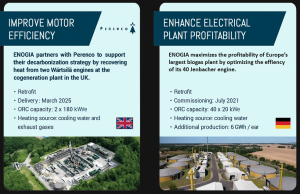
Founded in 2009 in Marseille, Enogia is a pioneering French company in the conversion of heat into electricity thanks to ORC technology (Organic Rankine Cycle). This unique expertise allows Enogia to support industrials and energy players in the valorization of their heat sources, whether they are residual or renewable.
In just over ten years, Enogia has become a key player in France and abroad, with more than 210 ORC references deployed in 29 countries and around fifty employees. Listed on Euronext Growth Paris since 2021, the company continues its development around innovative solutions that contribute to energy efficiency and ecological transition.
The ORC Enogia in 3 key points:
- Compact, plug & play and automatic modules (no need for operators)
- A robust and proven technology, guaranteeing secure business plans with attractive return on investment times
- Decarbonized electricity production adapted to various industrial processes
Enogia ORC systems use waste heat from various sources (exhaust gases, hot water, steam, thermal oils, etc.) to generate electricity. The process is based on four main steps:
- Evaporation: the heat is transferred to the working fluid via a heat exchanger.
- Expansion: the evaporated working fluid drives a compact turbine, directly coupled to an alternator. Mechanical energy is thus converted into electrical energy.
- Condensation: at the exit of the turbine, the fluid passes into a water-cooled or air-cooled condenser. It returns to its liquid state.
- Recirculation: a pump reinjects the fluid into the evaporator to start a new cycle.

The Enogia ORCs are perfectly suited to the valorization of waste heat from 75 °C.
These thermal emissions are present in many industrial and energy sectors, such as:
- Agri-food
- Chemistry
- Textile
- Stationery
- Generators (biogas, diesel, natural gas)
- Incinerators (waste, biomass)
- Other industrial processes generating waste heat
| Characteristics | Values |
|---|---|
| Electric power range | 10 à 180 kWe |
| Minimum temperature heat source | > 75 °C |
Required thermal power | > 200 kWth |
The electrical power range of Enogia ORCs can reach up to 3 MWe by combining several modules. Thanks to a containerised and modular design, these systems easily adapt to the needs of industrial sites, allowing gradual ramp-up and simplified integration.
- ORC modules adapted to low and medium temperatures (from 75°C to 350°C)
Compact design - Simplified integration, only two pipe fittings and a power cable are required for commissioning
- Low carbon footprint thanks to the use of a refrigerant with the lowest GWP on the market
Mail : commercial@ananke.eu
Phone : 06 75 08 58 16

Born from ANANKÉ’s expertise, KEOS is a cogeneration module powered by an external heat supply engine, inspired by the Ericsson engine principle, patented and specifically developed by ANANKÉ.
From a waste heat source, the KEOS module is capable of producing useful heat and, as required, compressed air or electricity.
This technical solution is fully in line with an energy efficiency approach and constitutes a particularly relevant lever for reducing both energy consumption and CO emissions of an industrial site.
Operating cycle :
1. Heating (waste heat recovery)
2. Relaxation (mechanical/electrical energy production)
3. Cooling (heat production)
4. Compression (drive by the regulator)
Below are some examples of sectors with valuation opportunities with KEOS:
- Steel industry
- Cement works
- Glassware
- Chemistry
- Incineration
| Characteritics | Values |
|---|---|
| Electric power supplied | 40 kW minimum |
| Minimum temperature heat source | 450 °C |
| Thermical power required | >300 kWh |
| Heat supply | Power : 200 kW minimum Temperature : 150 °C minimum |
Possible cogeneration
Patented technology
Adapted to high temperature emissions
Containerized module for simplified integration

Mail : commercial@ananke.eu
Phone : 06 75 08 58 16

Alongside the KEOS module, ANANKÉ has developed LEEFT, an innovative very high temperature heat pump. This technology is powered by the same patented engine as KEOS, operating with air as working fluid. This unique design offers a considerable advantage: it eliminates the use of regulated refrigerants.
The LEEFT PAC allows the valorization of waste heat flows by raising their temperature to +100°C compared to the initial level. It thus becomes particularly relevant when the process needs of an industrial site require higher temperatures than those directly available at the exit of the waste heat.
By combining energy performance and compliance with regulations, LEEFT is an efficient and sustainable technical solution to support manufacturers in their energy transition.
The LEEFT PAC is particularly aimed at industrial applications requiring thermal energy at a temperature level higher than that of available waste heat.
Example: Valorization of waste heat emissions to satisfy a drying process.
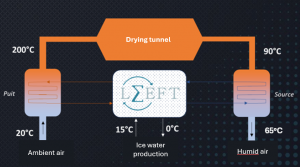
The LEEFT heat pump operates according to the same thermodynamic principle as the KEOS module, but in an inverted cycle. In this case, electrical energy is supplied to the engine in order to increase the temperature of the working fluid and to valorize the waste heat.
Its operation is based on five main steps:
Heating – recovery of an existing waste heat source.
Compression – elevation of the fluid temperature thanks to the motor.
Cooling – useful heat production for the industrial process.
Expansion – cooling of the gas at the end of the cycle.
Cold production
Agri-food: sterilization processes, steam needs, drying operations…
Chemistry: steam requirements, drying processes…
Stationery: drying processes
non-exhaustive list
| Characteristics | Values |
|---|---|
| Electrical power consumed by LEEFT | 25 kW to 650 kW |
| Temperature of the heat source | 20°C tp 300°C |
| Thermical power required | > 25 kWh |
| Heat supply | Power : 50 kW to 1 MW Temperature : 17°C to 400°C |
| Cold production | Power : 10 kW to 200 kW Temperature : -30 °C minimum |
No regulated refrigerants: thanks to its external heat supply engine working with air as the working fluid, LEEFT completely avoids the use of refrigerants subject to current and future regulatory constraints. It is a guarantee of sustainability and simplicity of operation.
A unique temperature range on the market: capable of boosting waste heat up to +100°C, with a heat supply up to 300°C, LEEFT covers industrial needs inaccessible to conventional PACs.
A lever for sustainable competitiveness: by valorizing thermal emissions while meeting process needs, LEEFT allows reducing both energy costs and CO emissions.
Mail : commercial@ananke.eu
Phone : 06 75 08 58 16

ETNA is a thermal emission measurement instrument developed by ANANKÉ.
It enables you to:
Quantify the thermal power available in flue gases to identify waste heat recovery potential
Analyze the chemical composition of flue gases
Monitor flue gas characteristics in real time without disrupting industrial processes
Identify the most suitable waste heat recovery solution available on the market
All collected data is transmitted to a web interface and consolidated into a report delivered to the client.

SIMPLICITY & SPEED
A single unit contains all the instrumentation components, making integration into your stack easy. Installation is quick, requiring only an electrical connection and wireless network access.
SECURITY
Through the platform developed by Ananké, you can view the collected data in real time throughout the measurement period. Your unique and secure client account, created upon installation, ensures full confidentiality.
COMPETITIVENESS
The Etna service is eligible for financial support as part of an energy audit or an energy efficiency project. Recognized as an innovative solution by ADEME and AER, you may benefit from funding of up to 70% depending on the size of your company.
Mail : commercial@ananke.eu
Phone : 06 75 08 58 16
